Bridging UAV Icing Innovations to Clean Aviation


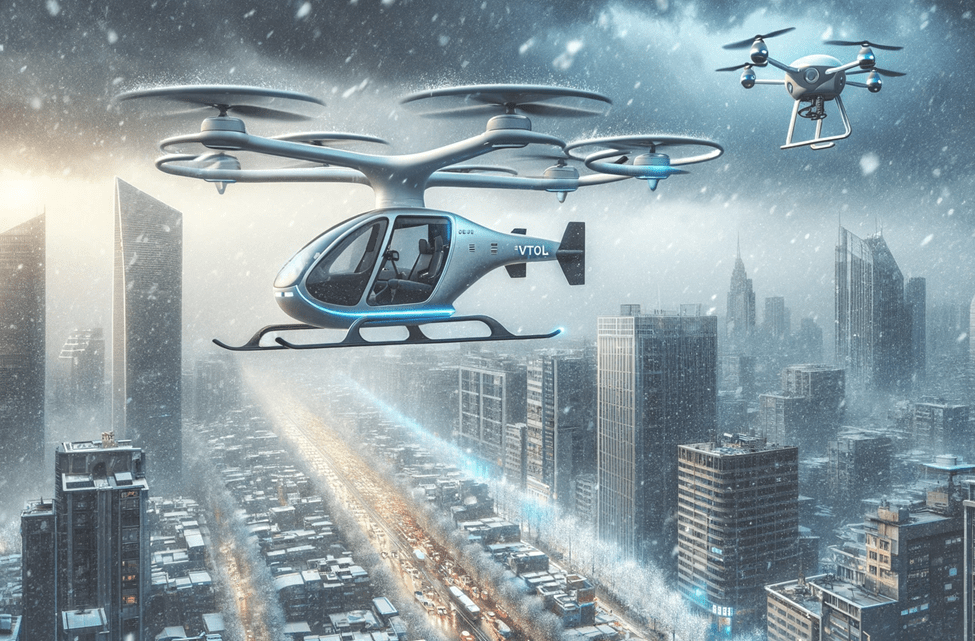
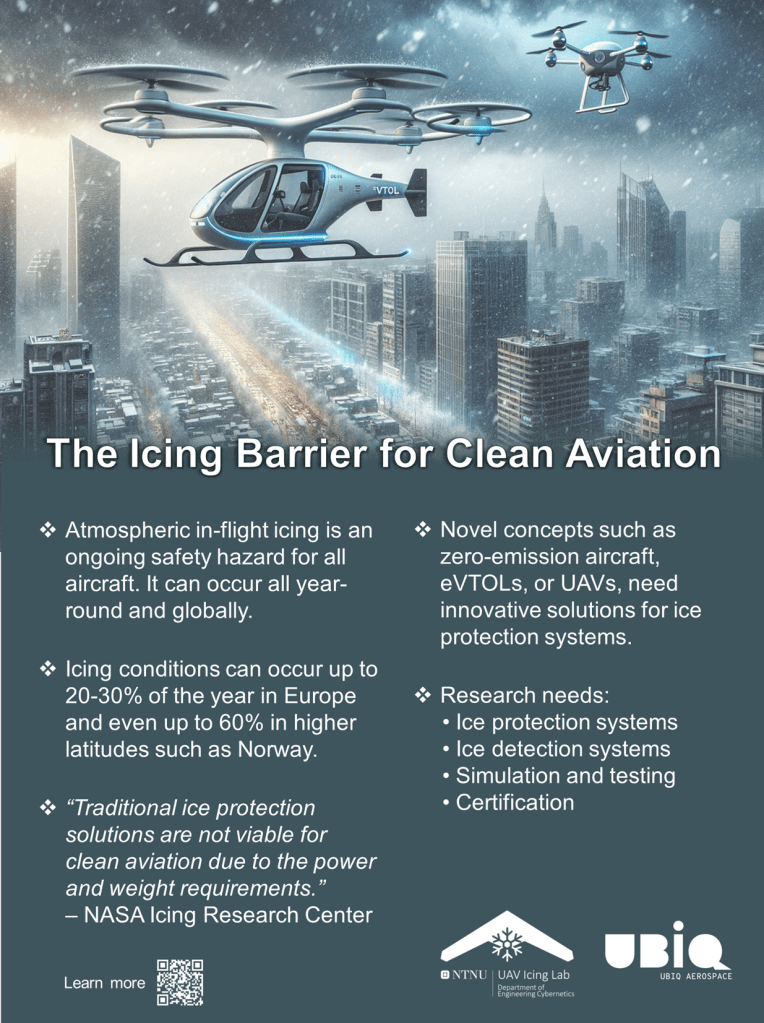
Last week, our team from the UAV Icing Lab had the privilege of attending the NTNU Clean Aviation evening with Rolls-Royce, Avinor, and Widerøe. This event not only provided us with a deeper understanding of the latest trends in aviation technology but also opened our eyes to the significant potential for synergy between our work on UAV icing solutions and the emerging field of zero-emission aircraft.

The Challenge of Power Budget in Zero-Emission Aircraft
One of the most striking revelations from the event was the tight power budget that fully-electric or hydrogen-powered aircraft operate within, especially when compared to traditional aviation. These innovative aircraft designs are at the forefront of clean aviation, aiming to reduce emissions and revolutionize air travel. However, their success hinges on efficiently managing power consumption, a challenge where our expertise in UAV icing solutions can play a crucial role.

UAV Icing Solutions: Optimized for Efficiency
Our work at the UAV Icing Lab has always been geared towards optimizing solutions for size, weight, and power. These considerations are paramount in UAV design, where every gram and watt counts. By adapting these icing solutions, initially developed for UAVs, to clean aviation aircraft, we can significantly reduce the power consumption required for ice protection systems. This reduction is not just a technical improvement; it’s a critical step in making zero-emission aircraft feasible and viable.

The Road Ahead
Inspired by the discussions and insights gained at the NTNU Clean Aviation evening, the UAV Icing Lab is now more committed than ever to contributing actively to the clean aviation sector. We are excited to announce that we will be focusing on developing new research projects aimed at adapting our UAV icing innovations for use in zero-emission aircraft. This direction not only aligns with our expertise but also contributes to a more sustainable and environmentally friendly aviation industry.

New Advancements in Ice Protection Systems for UAV propellers 

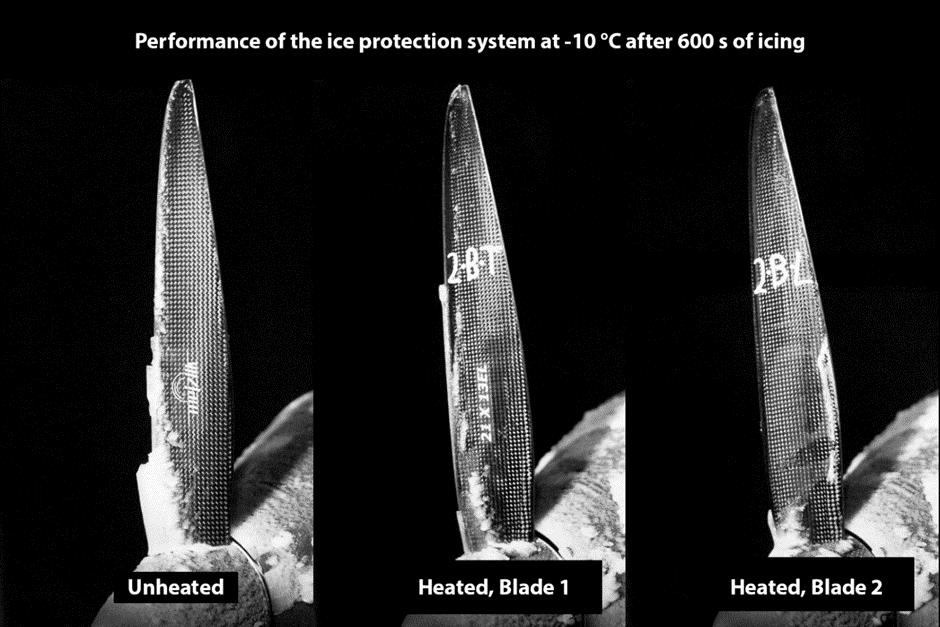
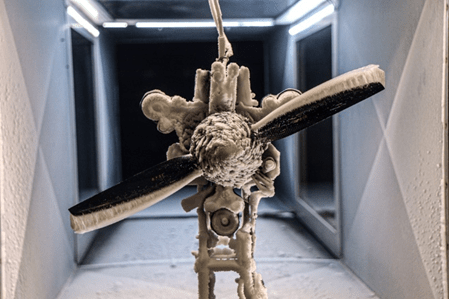
The NTNU UAV Icing Lab, together with Mejzlik Propellers, and UBIQ Aerospace have developed a system to protect the propellers of UAVs when flying in icing conditions. In clouds in cold conditions, the propeller can collect ice and reduce the aerodynamic efficiency of the propeller. The developed electro-thermal ice protection system prevents ice accretion and retains propeller performance in icing conditions. Our research opens new possibilities for safe and reliable UAV operations in challenging weather environments. 

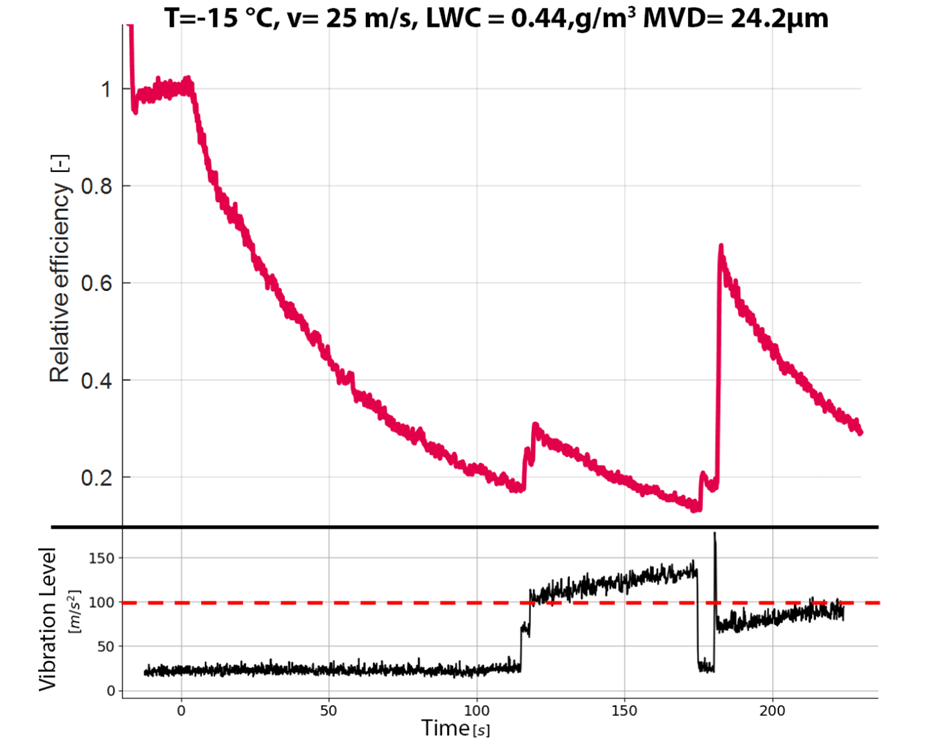
Ice accretion will decrease the propeller’s performance by disturbing the airflow around the propeller blade. This will lead to a significant loss of thrust and strong vibrations.  Propellers are very sensitive to icing and ice up very fast – within 100s the propeller can lose more than 80% of its efficiency. In addition, vibrations exceeding 10G can damage the drive train. These effects are a large hazard to the UAV and can lead to the loss of propulsion and subsequent loss of aircraft.

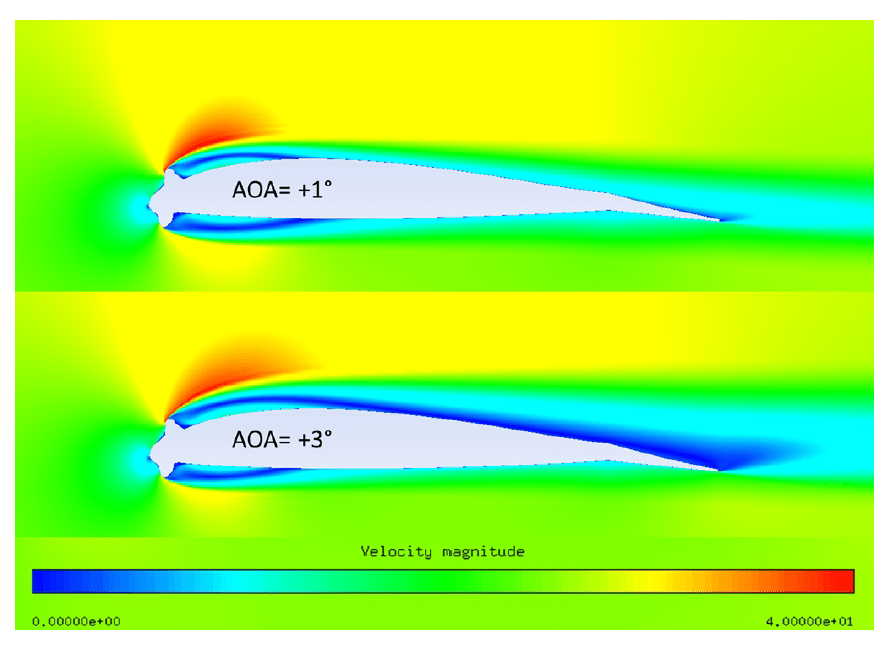
We used state-of-the-art CFD techniques to engineer an advanced propeller ice protection system tailored for in-flight use during icing conditions. The system incorporates carbon fiber heaters within the propeller blade, deterring ice formation and facilitating the shedding of any formed ice. 

The developed ice protection system was able to prevent ice accretion at a temperature of -5°C, and at lower temperatures, it was able to reduce the impact of atmospheric icing on the propeller significantly.   

This collaborative effort with UBIQ Aerospace, the UAV Icing Lab and Mejzlik Propellers represents the first step in developing a mature ice protection system for UAVs. This will enable UAV operations in cold-climate regions. 

Reference: Müller, N.C., Løw-Hansen, B., Borup, K.T., Hann, R. (2023). UAV icing: Development of an ice protection system for the propeller of a small UAV. Cold Regions Science and Technology, 213, 103938. doi.org/ 10.1016/j.coldregions.2023.103938

Text: Nicolas C. Müller

Reflecting on 2023

As the year 2023 comes to a close, it’s time to look back at a year filled with significant achievements and advancements in the field of Unmanned Aerial Vehicle (UAV) icing research. It has been an important year for the UAV icing research field and the NTNU UAV Icing Lab has contributed some of the key achievements.

Highlights from 2023

  1. SAE Icing Conference: This year’s SAE Icing Conference in Vienna was a landmark event for UAV icing research. It featured a record number of papers dedicated to UAV icing. Our lab proudly contributed six of these papers on a wide range of topics such as icing on wings, propellers, ice protection systems, path-planning, and ice detection.
  2. 2nd AIAA Ice Prediction Workshop: The 2nd edition of this workshop was another highlight of the year. Our lab contributed a UAV icing case with low Reynolds numbers that was featured in this important workshop. The results showcased that many ice prediction codes have substantial gaps for simulations of UAV icing cases.
  3. Collaboration with UBIQ Aerospace: Perhaps one of our most impactful collaborations of 2023 was with UBIQ Aerospace. Together, we developed an ice protection system for UAV propellers. This system was tested under moderate icing conditions and impressively maintained 70% efficiency over a 10-minute period. This success marks a significant step forward in our quest to make UAVs safer and more efficient in icy conditions.

Outlook for 2024: Expanding Horizons

As we move into 2024, the UAV Icing Lab is poised for another year of innovation and discovery.

  1. 2nd UAV Icing Workshop: Building on the success of our previous workshops, we are excited to host the 2nd UAV Icing Workshop. This will be a platform for sharing new research, fostering collaborations, and discussing the future directions of UAV icing research. More information will follow soon.
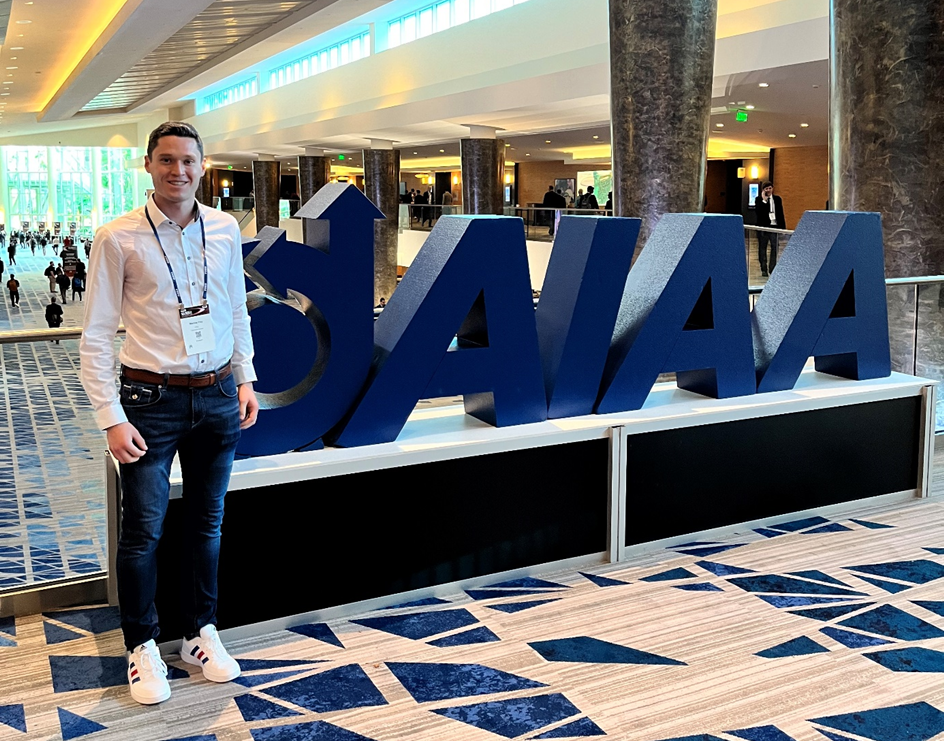
  2. AIAA Aviation Conference in Las Vegas: We are geared up for the AIAA Aviation Conference in Las Vegas, where we aim to submit six papers. Our ongoing research promises new insights and advancements in UAV icing, and we look forward to sharing these with the global community.
  3. Continued Collaborations and Wind Tunnel Tests: Our journey doesn’t stop here. We will continue our collaborations with industry partners and conduct more icing wind tunnel tests. These efforts are vital for developing more effective icing mitigation strategies and technologies for UAVs.

The NTNU UAV Icing Lab wishes you happy holidays and a good start to an exciting 2024!

Optimizing Ice Protection Systems for UAVs: Striking the Balance Between Energy Efficiency and Flight Safety 

**NEW PUBLICATION** Atmospheric in-flight icing is a significant threat for all aircraft, in particular for unmanned aerial vehicles (UAVs). Hence, most UAVs require a mitigation plan in order to fly safely in icing conditions, at least in the more severe icing conditions. One way of protecting the aircraft against the negative influences of icing is the use of ice protection systems (IPS). Most research on IPS for UAV wings has been with electrothermal IPS, i.e., systems that heat the protected area electrically above the freezing temperature. 

What is known and what isn’t 

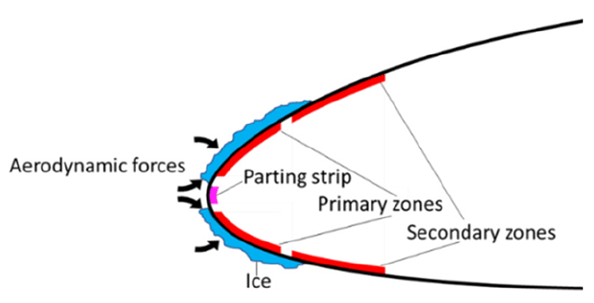
Previous studies (How much energy is required to prevent ice on UAVs? and Efficient ice protection systems – Timing is everything) found that the operation of the electrothermal IPS in de-icing mode required less energy than the operation as anti-icing system. De-icing systems allow some ice to accumulate before the ice is removed, while anti-icing systems prevent ice to accumulate on the protected surfaces at any time. Additionally, previous studies showed that the usage of a parting strip increases the energy efficiency of the IPS. The parting strip is a continuously heated element that is located at the leading edge of the wing and divides the ice shape into two parts. As can be seen in the figure above, this allows the aerodynamic forces to push the ice from the wing once the primary and secondary zones have melted a sufficient layer of ice. 

Several studies exist that aimed to optimize the energy used on thermal de-icing IPS. However, only few studies also considered the aerodynamic influence of intercycle ice. Intercycle ice is the ice that is allowed to accrete before the de-icing is started. The studies that also considered the intercycle ice shapes typically only investigated the ice thickness of the intercycle ice. To our knowledge, no study exists that quantifies the energy required for an IPS and the energy required to generate enough thrust for the UAV to continue its flight in icing conditions. This gap is intended to be filled with the new publication. 

Energy efficiency – new results 

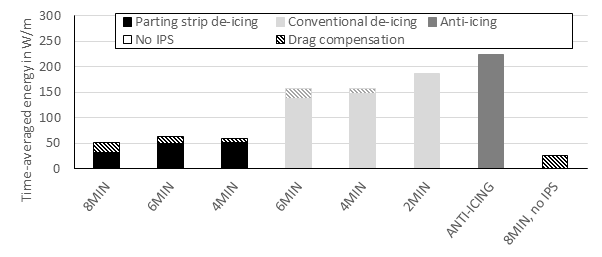
For this study, the required IPS energy was determined experimentally from icing wind tunnel tests. The intercycle ice shapes and the drag increase they cause were simulated using the icing CFD code ANSYS FENSAP-ICE. An exemplary result is shown below for the flight of a UAV in icing conditions at −2 °C with different intercycle times and allows for multiple findings. First, the required energy to compensate for intercycle drag is smaller than the energy required for an IPS. As a result, parting strip de-icing remains more energy-efficient than conventional de-icing and anti-icing, even when considering the intercycle drag. Second, the added intercycle drag can cause shorter intercycle times to be more energy-efficient than longer intercycle times. Third, flying without an IPS can be the most energy-efficient setting when only looking at the energy required to fly through a specified cloud. 

So should UAVs fly without IPS? 

While the results of the study indicate that no IPS might be the most energy-efficient method of flying in icing conditions, this does not mean that it is the best option for a UAV to not have an IPS at all. First, the study only compares the energy required for the flight through a specified cloud. If the UAV was not equipped with an IPS, it would continue to fly with the reduced aerodynamics caused by the ice accretion even after exiting icing conditions. Thus, when comparing an entire flight, flying with an IPS is likely to be more energy-efficient than flying without an IPS. Second, the quality of an IPS does not only depend on its energy efficiency. Ice accretions on the wing also reduce the stall angle and increase the risk of accidents in flight situations with larger angles of attack, e.g., during the approach. Furthermore, ice accretions are likely to reduce the maneuverability and stability of the aircraft. Hence, the perfect usage of an IPS is likely dictated by the amount of ice that can be on the wing of an aircraft without risking the aircraft to become unstable. 

The new publication presents valuable information on the energy efficiency of IPS for the wings of UAVs. This knowledge helps to develop better IPS and to implement IPS settings that optimize the energy need. The results show that longer intercycle times are in general more energy-efficient but the influence of intercycle ice on the aircraft’s stability was neglected in this study. Hence, for a further optimization of the IPS, investigating the influence of intercycle ice shapes on the stability and maneuverability of aircraft is required. 

Reference: Wallisch, J. and Hann, R., “UAV Icing: Intercycle Ice Effects on Aerodynamic Performance,” SAE Technical Paper 2023-01-1400, 2023, https://doi.org/10.4271/2023-01-1400. 

Text: Joachim Wallisch

Title image: Microsoft Bing Image Creater

Solving the in-flight ice detection challenge: Keeping small drones safe in the skies

The skies are not always as friendly as they seem, especially when flying in cold weather conditions. Although aircraft icing is considered solved for larger aircraft in civil aviation, the challenge of icing is relatively new and unexplored in the context of small drones and uncrewed aerial vehicles (UAVs). In this blog post, we will explore recent developments in ice detection solutions suitable for small UAVs, shedding light on the ongoing efforts to keep these remarkable flying machines safe amidst harsh weather conditions.

The Ice Predicament: In-flight icing, or the accumulation of ice on aircraft surfaces during flight through clouds, poses a formidable challenge for the UAV industry. While conventional aircraft have mature solutions to tackle this issue, manufacturers and users of small fixed-wing UAVs still grapple with limited options. Often, the only solution is to postpone the flight until icing conditions subside, significantly reducing their operational efficiency.

The UAV Revolution: The rapid rise of small UAVs, commonly known as drones, has taken the world by storm. These unmanned aerial vehicles find applications in diverse industries, from aerial photography to package delivery, agricultural surveys, and environmental monitoring. Their compact size, cost-effectiveness, and versatility have sparked immense commercial interest, leading to innovative applications that seemed like science fiction only a decade ago. As we envision UAVs soaring through the skies to fulfill various tasks, ensuring their safety becomes paramount. An essential prerequisite for effective ice protection solutions is real-time ice detection systems (Løw-Hansen, 2023). This is where our NTNU UAV Icing lab is stepping up to the challenge, investigating novel methods to keep small UAVs flying safely even in icing conditions. In a recent publication, we presented a survey about recent developments in ice detection on UAVs at the IFAC World Congress 2023 in Yokohama.

The Indirect Approach: One promising approach is indirect ice detection methods, which are based on closely monitoring the aircraft’s performance during flight. These performance-based techniques analyze flight data and employ sophisticated algorithms to detect any degradation in the UAV’s aerodynamic capabilities due to ice build-up. The beauty of these methods lies in their ability to be implemented retrospectively with minimal aircraft modification. This translates to cost-effective and practical solutions for the growing fleet of UAVs.

Hybrid Solutions: A Perfect Blend for UAV Safety While the indirect methods are promising, researchers are exploring even more powerful solutions by combining the speed and accuracy of direct methods, which directly sense the presence of ice, with the broader insights from indirect methods. For instance, the SENS4ICE group presented groundbreaking findings at the SAE icing conference this summer (Deiler, 2023). Their hybrid detection methods have generated considerable interest, and though initially developed for larger aircraft, the potential for an equivalent solution for UAVs should be too difficult to develop.

Towards a Safer Sky: In conclusion, the journey to ensure the safety of small UAVs in icy skies is a continuous endeavor. While ice hazards are under control for general aviation, there is much ground to cover concerning UAV-specific ice detection solutions. The ongoing research by groups like the NTNU UAV Icing lab, together with the exciting developments presented by the SENS4ICE group, underscores the commitment to conquer the in-flight icing challenge for small drones. As technology advances and collaboration thrives, the skies of tomorrow hold the promise of a safer and more efficient UAV fleet, opening up new frontiers for these remarkable flying machines.

Text: Bogdan Løw-Hansen

References:
Løw-Hansen, B., Hann, R., Stovner, B. N., Johansen, T. A. (2023). UAV Icing: A survey of recent developments in ice detection methods. 22nd IFAC World Congress, Yokohama.

Deiler, C., & Sachs, F. (2023). Design and Testing of an Indirect Ice Detection Methodology (No. 2023-01-1493). SAE Technical Paper.

UAV icing research takes flight at the SAE icing conference in Vienna

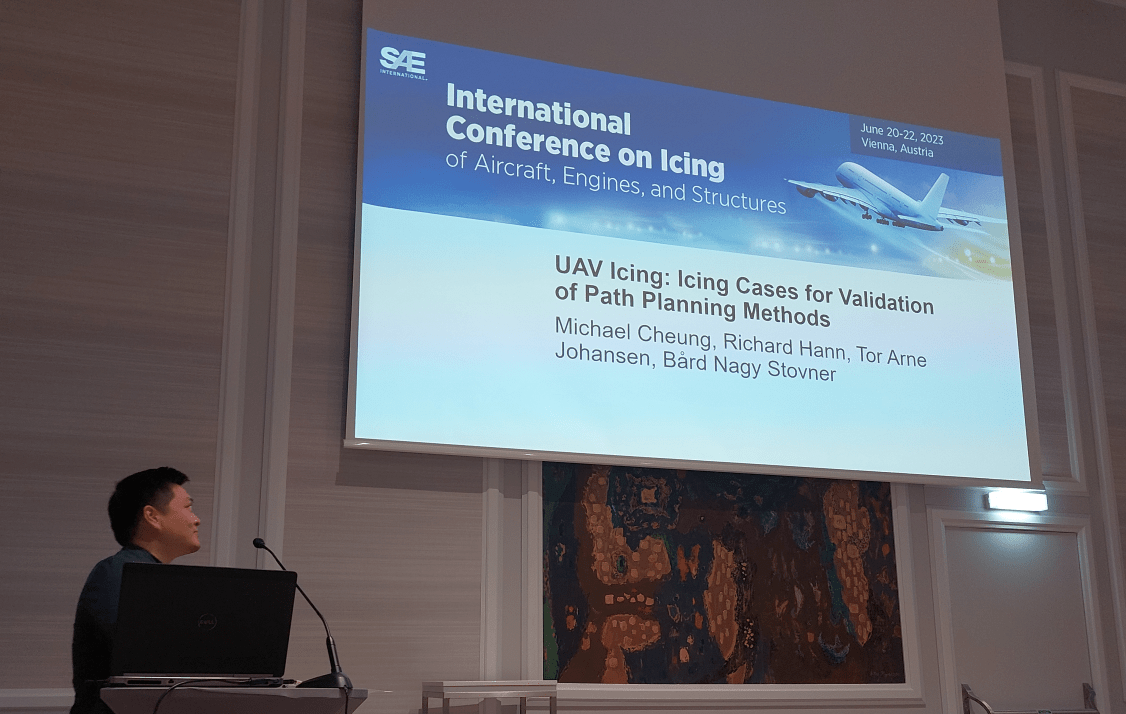
The NTNU UAV Icing Lab recently made a significant contribution to the SAE International Conference on Icing of Aircraft, Engines, and Structures in Vienna. Our team showcased our research results by presenting seven papers.

As leaders in the field of UAV icing research, we are dedicated to providing knowledge and solution for unmanned aircraft operations in cold weather conditions. We proudly contributed seven research papers, showcasing our expertise in UAV icing and highlighting the challenges of adverse weather conditions. Our research explored intercycle ice effects on aerodynamic performance, conducted experiments of an electrothermal propeller ice protection system, developed performance-based ice detection of an electric propulsion system, provided validation ice shapes at low Reynolds numbers, simulated icing effects on wings and empennage, generated validation cases for a path-planning tool, and performed ice accretion simulations and experiments on a UAM eVTOL rotor.

By sharing our findings and insights at the conference, we contributed to the advancement of knowledge in the field of UAV icing while also promoting collaborations with experts from around the globe.

Stay tuned to more in-depth updates about the papers that we presented at the conference.

References:

Wallisch, J., Hann, R., (2023). UAV Icing: Intercycle Ice Effects on Aerodynamic Performance. SAE International Conference on Icing of Aircraft, Engines, and Structures. DOI: 10.4271/2023-01-1400

Müller, N.C., Hann, R., (2023). UAV Icing: 3D simulations of propeller icing effects and anti-icing heat loads. SAE International Conference on Icing of Aircraft, Engines, and Structures. DOI: 10.4271/2023-01-1400

Løw-Hansen, B., Müller, N.C., Coates, E., Johansen, T.A., Hann, R., (2023). Identification of an Electric UAV Propulsion System in Icing Conditions. SAE International Conference on Icing of Aircraft, Engines, and Structures. DOI: 10.4271/2023-01-1378

Cheung, M., Johansen, T.A., Hann, R., (2023). UAV Icing: Icing Scenarios for Validation of Particle Swarm Path Planning Method. SAE International Conference on Icing of Aircraft, Engines, and Structures. DOI: 10.4271/2023-01-1379

Hann, R., Müller, N.C., Lindner, M., Wallisch, J. (2023). UAV Icing: Experimental validation data for predicting ice shapes at low Reynolds numbers. SAE International Conference on Icing of Aircraft, Engines, and Structures. DOI: 10.4271/2023-01-1372

Lindner, M., Wallisch, J., Hann, R. (2023). UAV Icing: Numerical Simulation of Icing Effects on Wing and Empennage. SAE International Conference on Icing of Aircraft, Engines, and Structures. DOI: 10.4271/2023-01-1384

Heramarwan, H., Müller, N., Lutz, T., Hann, R. (2023). UAM Icing: Ice Accretion Simulations and Experiments of an eVTOL Rotor. SAE International Conference on Icing of Aircraft, Engines, and Structures. DOI: 10.4271/2023-01-1391

Icing wind tunnels – an universal tool for icing research?

One of the challenges to the safe and reliable operation of aircraft is the hazard of in-flight icing. Ice accretions on the aircraft happen when supercooled droplets – droplets that are liquid although their temperature is below freezing – hit the surface. Depending on the position where the ice grows, different problems can arise. Ice accretions on wings reduce the lift and increase the drag of the aircraft. Ice on propellers can reduce the thrust and increase the required power significantly within one or two minutes. When sensors or antennas ice up, their output might be faulty or stop completely. Overall, icing on aircraft has multiple negative effects that can cause a crash in the worst case.

Hence, icing research has been an important field within the aircraft community for more than seven decades. Two different main areas of research can be distinguished. First, understanding the physics behind icing and how ice accretions affect different parts of the aircraft. Second, developing and testing solutions to protect aircraft that fly in icing conditions. Different methods are used to conduct the research. The foundation has been laid by performing theoretical research about the path of droplets in the air, where they impinge, and what factors influence the rate of droplet freezing. This research has been supported by performing experiments. A second, more recent method is the use of numerical simulations.

A propeller mounted inside an icing wind tunnel.

While numerical simulations allow investigating a wide range of different conditions, they cannot serve as a standalone tool. This is because the equations that are used to do the numerical calculations are often not exact replications of the true processes but require modeling of some parameters. The model tuning is typically done by comparing numerical simulations to experimental results. Hence, experimental tests play a very significant role in the field of icing research. Experiments can have different levels of complexity and similarity to the conditions found in real flights. Especially some of the foundational work has been done in conditions that are different from real applications, for example by using flat plates as the geometry. These experiments still allow gaining insight into the theory behind icing. However, when we aim to understand in more detail how different parts of aircraft are affected or can be protected, the experimental conditions must be closer to the conditions in real flights (real geometries, sizes, ambient conditions, etc.).

The highest similarity to real flights can be achieved by performing flight tests. The goal is to operate the aircraft in real icing conditions and investigate the effect of icing or the performance of the protection solutions. Two big challenges related to flight tests in icing conditions exist. First, it is extremely difficult to find icing conditions and it can take a very long time to conduct enough flight tests to cover the wide range of potential cloud conditions. Second, measuring all important variables, related to both the ambient conditions and the influence of ice accretions, during the flight is challenging or even impossible. Thus, experiments in icing wind tunnels are a popular alternative since they allow testing at different conditions in a controlled manner.

Wind tunnels can be open return wind tunnels or closed return wind tunnels. Pictures taken from Open Return Wind Tunnel (nasa.gov), Closed Return Wind Tunnel (nasa.gov)

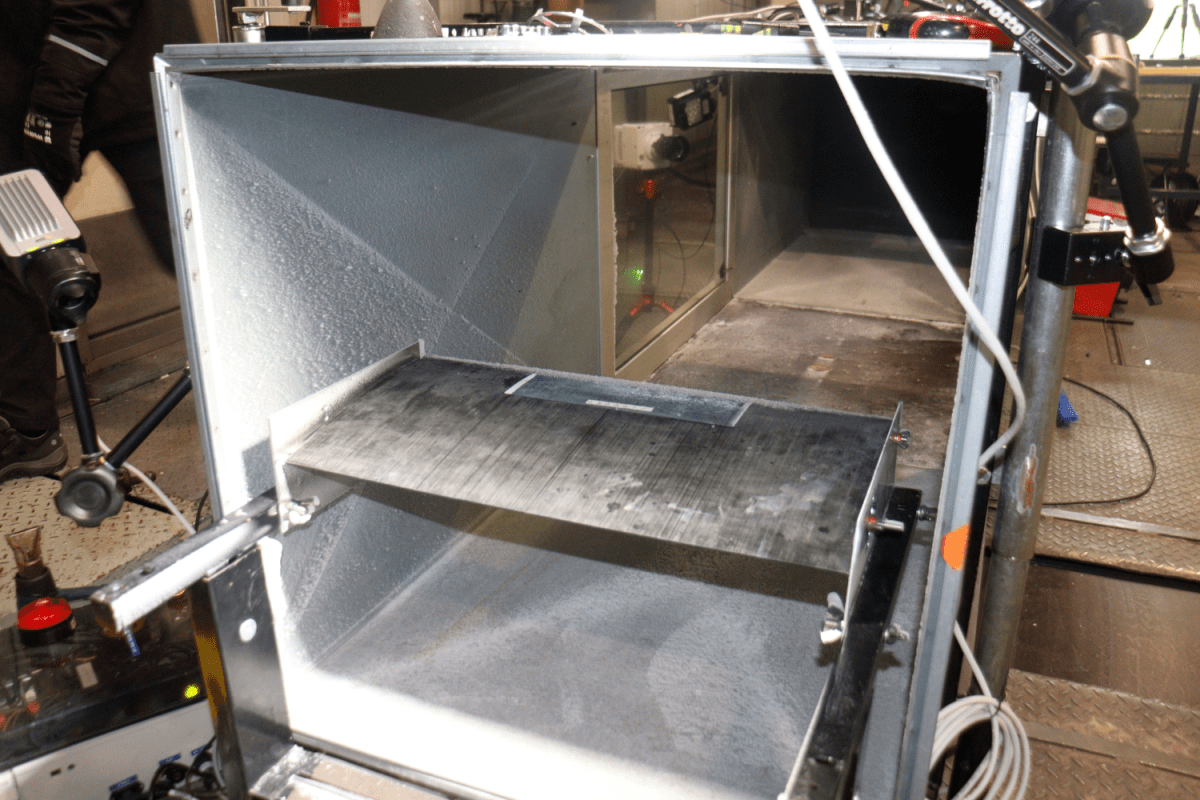
Like conventional wind tunnels, icing wind tunnels have fans to create an airflow through the tunnel and towards a test object, for example, a wing or a propeller. The special feature of icing wind tunnels is that they can recreate conditions as aircraft could find them in icing clouds during a flight. To do so, icing wind tunnels are equipped with a spray system to spray droplets into the airflow. Additionally, the air in the tunnels can be cooled down below freezing to supercool the droplets before they hit the test object. This can be achieved by having a heat exchanger that only cools down the air that flows through the closed return tunnel, or by having an open wind tunnel and cooling down the whole room, see figures above. Hence, testing in icing wind tunnels allows performing experiments that are close to real icing conditions in a controlled environment. This is an important tool since it allows testing at specified conditions without having to wait or search for them for a long time. Additionally, the physics does not have to be modeled, as is the case for numerical simulations.

But unfortunately, there are also shortcomings of experiments in icing wind tunnels. First, the number of facilities in the world is small. This also means that time in icing wind tunnels is limited and expensive. Second, all icing wind tunnels come with limitations in the range of conditions they can test. Except for the largest facilities in the world, the size of the test section is typically only in the range of one to three meters. Hence, testing full aircraft or even full wings for manned aircraft is typically not possible. This is especially challenging because scaling is a very difficult aspect of icing. To meet all similarity requirements of icing conditions, many parameters must be matched, often resulting in contrasting constraints. Hence, scaling of results is not commonly done. Additionally, also the range of ambient parameters that can be tested in icing wind tunnels depends on the facilities. Most facilities can only spray limited amounts of water in the air, only have limited speed variation, or are limited regarding the coldest temperatures they can keep during experiments. Last, but not least, the conditions in icing wind tunnels are no exact replicates of icing conditions in real flights. For example, the experiments in icing wind tunnels are typically performed at constant conditions during the whole run. However, in real clouds, the conditions can change significantly within a few hundred meters.

Summarized, icing wind tunnels are neither a universal tool for icing research nor a niche tool. Yes, icing wind tunnels have some shortcomings that reduce their capabilities. However, they are still a very important tool for performing icing research because they allow testing without the limitations of numerical models and without the very expensive and time-consuming task of finding icing conditions for real flights. Also, the other methods have their strengths and weaknesses. Hence, it is probably the combination of the different methods that leads to the best results. Using numerical simulations to cover wide ranges of icing conditions, verifying the results using icing wind tunnels, and finally confirming these findings in real flights should be the best use of all the different techniques and maximize the learnings.

Text: Joachim Wallisch

Developing robust UAV autopilot controllers for flight in icing

**NEW PUBLICATION**  In-flight icing is a severe risk for unmanned aerial vehicles (UAVs). In these conditions, ice accumulates on the wings and propellers which disturbs the airfoil. As a consequence, the aerodynamic performance of the wings and propeller is reduced. Ice also reduces the effectiveness of the control surfaces. Most UAVs use an autopilot system for flying which typically cannot cope well with these icing performance losses. In the worst case, the autopilot may even steer the UAV into a situation where it cannot maintain stable flight – and crash.

In our recent publication, we explore the use of a more robust autopilot, that can deal with the icing effects in a safe manner. We compare a model reference adaptive control (MRAC) scheme to PID controllers to maintain stable flight in icing conditions. The findings show that MRAC control scheme and the PID controller demonstrate similar qualities in tracking performance, with the MRAC performing better under certain conditions.

Reference: Högnadottir, S., Gryte, G., Hann, R., Johansen, T.A. (2023). Inner-Loop Control of Fixed-Wing Unmanned Aerial Vehicles in Icing Conditions. AIAA Sci-Tech Conference. DOI: 10.2514/6.2023-1049

Text: Richard Hann

Highlights of the UAV Icing Workshop

By Bogdan Løw-Hansen, Joachim Wallisch, Markus Lindner, Michael Cheung and Nicolas Müller

The 1st International Workshop on Unmanned Aircraft Icing took place in Trondheim on 29th-30th of November. The purpose of the workshop was to gather different stakeholders interested in unmanned aerial vehicle (UAV) icing, including – scientists, engineers, manufacturers, investors, operators, and authorities – and learn what other stakeholders are working on and where potential collaborations can be found.

Keynote presentations

The opening talk, given by Richard Hann, highlighted the significant growth of UAVs in the current commercial and defense markets, as well as the limitations that hinder even faster growth, one of them being the atmospheric icing.

In the first keynote speech, Kim Sørensen – CEO of UBIQ Aerospace – presented the commercial opportunities related to the UAV icing challenge. Since the current solution is to ground the UAVs if there is a potential for icing, and icing conditions are likely to occur in the range of 19 to 78 days a year in the US, there is a large potential market for ice protection systems (IPS), especially light-weight and energy efficient IPS that do not reduce the operational capabilities of the UAVs.

On the second day, Professor Peter Webley from the University of Fairbanks of Alaska highlighted the challenges of operating a UAV in the Arctic. An important takeaway from the presentation is that it is not sufficient to only protect the aircraft, as the other parts of the system, like the payload, the communication links, and the pilots on the ground are highly affected by cold weather and icing as well. Therefore, a holistic view on the operations is required to ensure safe operation of UAVs in cold climates.

Research topics

Even though UAV icing might seem like a very narrow field, based on the topics presented at the workshop, it is clear that it is a challenge that has engaged a multidisciplinary effort towards a solution. The UAV icing topic has attracted several specialists from the UAV industry, research institutions, and academia that work on solutions to enable UAV operations in icing conditions. The research presented during the workshop can be categorized into the following groups:

  • Meteorology analysis and prediction of icing conditions
  • Efficiency optimization of heat-based ice protection systems
  • Efficient and lightweight ice detection sensors and methods for small UAVs
  • Development of testing facilities for atmospheric icing conditions
  • Research on icephobic materials and coatings
  • Regulations and certification of systems for unmanned flight in icing conditions

Highlights

Many interesting facts were presented during the two-day workshop; some of the most interesting highlights are mentioned below.

Today, UAV operations are severely limited by icing. As Kim Sørensen quoted in his keynote, the current solution to UAV icing is to not fly in icing conditions:

Standard procedures for UAS operations: avoid icing at all costs. Ground the aircraft in the event of potential icing. – Boeing Insitu

Another important finding was that the main challenge of developing a viable IPS for small UAVs is to make it efficient. The current solutions require large amounts of power and are therefore highly limited by the low battery capacity of small UAVs.

Finally on the point of frequency and severity of icing conditions, VTT (Technical Research Centre of Finland), has performed a high-resolution meteorological analysis of atmospheric icing conditions in the altitude 0-1000 m, relevant for small UAVs. The results indicate that severe icing conditions will on average occur 12.8% or 47 full days per year in the region of northern Europe.

Concluding remarks

Based on the feedback, the 1st International Workshop on Unmanned Aircraft Icing was a success. The shared interest and different backgrounds of the presenters created good opportunities to find synergies and build new connections. Several social events were organized to accompany the workshop, including an informal icebreaker event held the evening before the workshop, lunch and dinner served at Scandic Nidelven Hotel, as well as a visit to a bar, which all provided an excellent opportunity to socialize.

The 2nd International Workshop on Unmanned Aircraft Icing is planned to take place in 2024. Subscribe to our newsletter to stay updated about the research done at NTNU UAV Icing Lab and the upcoming events. More information will follow on: www.uavicingworkshop.com.

Succesful workshop!

One week after the 1st UAV Icing Workshop in Trondheim, we thank all participants for joining! With your support, we have made this event into a successful forum for discussing UAV icing-related challenges in research, industry, and regulations. More than 80 participants were registered for the event with about half of them physically present in Trondheim. We had representatives from 16 countries, spanning all around the globe. Many European countries, but also Canada, USA, South Korea, China, and New Zealand – resulting in the working being a truly international forum! Furthermore, about 60% of the participants had a background in research, 15% in industry, 10% in government, and 5% in defense.

We are happy to announce that the UAV Icing Workshop will return again in 2024! More information will follow on: www.uavicingworkshop.com.