
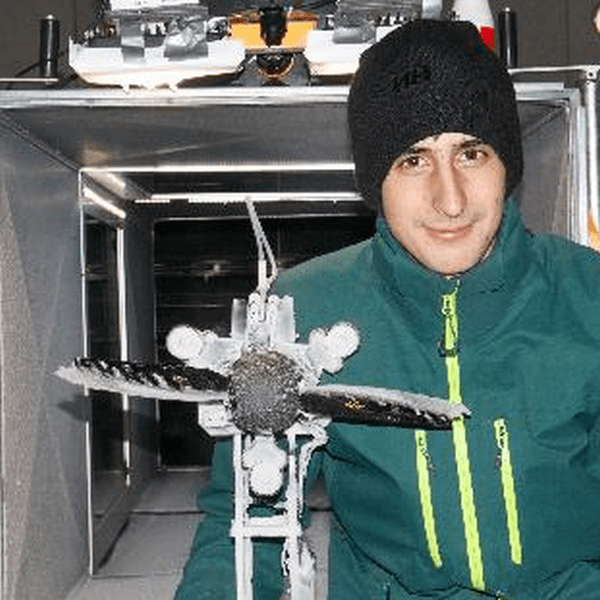
Doctoral candidate Nicolas Carlo Müller at the Department of Engineering Cybernetics and UAV Icing Lab will hold a trial lecture and defend his doctoral thesis for the degree of philosophia Doctor (PhD.)
Thesis title: Ice accretion effects and ice protection systems for UAV propellers
Trial lecture: Pathways to Certifying UAVs for Icing Conditions: Technical Requirements (civil & defense), Means of Compliance, Certification by Simulation, and Remaining Gaps
Time and venue
The PhD trial lecture and defence are both open to the public:
Trial lecture: 15 July 2026 at 10:15 – Disputasrommet, Main Building, Gløshaugen, NTNU
Defence of thesis: 15 July 2026 13:15 – Disputasrommet, Main Building, Gløshaugen, NTNU
Assessment Committee
First opponent: Senior Scientist Mariachiara Gallia, Technische Universität Braunsweig
Second opponent: Associate Professor Reinhardt Puffing, FH Joanneum University of Applied Sciences
Internal member: Associate Professor Dinesh Krishnamoorthy Kallur, Department of Engineering Cybernetics. He is also is appointed as the administrator of the assessment committee.
The committee has concluded that the thesis is worthy of public defense for the PhD degree.
Supervisors
Main supervisor: Dr Richard Hann
Co-supervisor: Professor Tor Arne Johansen
Abstract
As unmanned aerial vehicles (UAVs) increasingly support critical missions in cold climates, atmospheric icing poses a severe threat to their operational safety. This dissertation presents a numerical and experimental analysis of UAV rotor icing and introduces novel mitigation strategies to ensure reliable all-weather flight. Utilizing a hybrid approach that combines icing wind tunnel experiments with high-fidelity computational fluid dynamics (CFD) modeling, this research characterizes the complex thermodynamics of ice accretion on small-scale rotating blades. The study quantifies the aerodynamic penalties, including thrust degradation and power increases, caused by various icing conditions. To address these vulnerabilities, the thesis proposes and evaluates a electro-thermal anti-icing system. Evaluation of the system in an icing wind tunnel demonstrates the ability to reduce the performance penalties from ice accretion on the propeller and minimize the power consumption of the system. This work provides a key step to enable UAVs to operate in adverse weather conditions by maintaining the propulsion capabilities of the UAV.

