
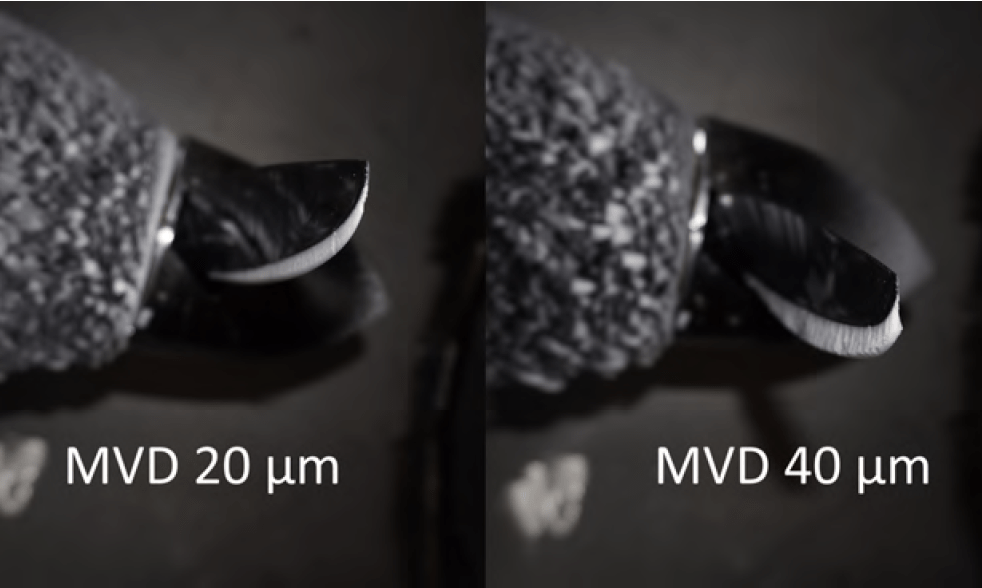
**NEW PUBLICATION** In one of our recent icing wind tunnel campaigns, the NTNU UAV Icing Lab investigated how ice accretion affects the performance of a UAV propeller in collaboration with Ubiq Aerospace and the Université du Québec à Chicoutimii (UQAC). What happens when a drone rotors are exposed to icing conditions and start to develop irregular ice shapes?
The answer: performance can collapse in less than a minute.
In controlled icing conditions in the icing wind tunnel facilities of the UQAC Anti-Icing Materials International Laboratory, we exposed a 53 cm-diameter carbon-fiber propeller to different temperatures, droplet sizes, and liquid water contents. While ice mass certainly increased with harsher conditions, the most important factor was not how much ice formed — but how it formed.
Small droplets produced relatively smooth, streamlined ice shapes with moderate performance loss. Larger droplets created rough, horn-like ice structures. These disrupted the airflow so severely that thrust dropped to zero — and in the worst cases, the propeller began generating drag instead of thrust.
For small UAVs operating close to their performance limits, this is critical. A rapid thrust loss combined with increased power demand can quickly lead to loss of control.
Our results show that droplet size and temperature strongly influence ice shape — and therefore risk. Understanding these mechanisms is essential for designing effective ice protection systems and enabling reliable UAV operations in cold climates.
We are currently working on improved modeling and mitigation strategies to better predict and manage these icing effects.
Publication: Müller, N.C., Villeneuve, E., Hann, R. (2026). UAV Icing: Experimental Characterization of the Performance Impact of Ice Accretion on a Propeller. Drones, 10(3), 166. doi.org/10.3390/drones10030166
 UAV Icing Lab