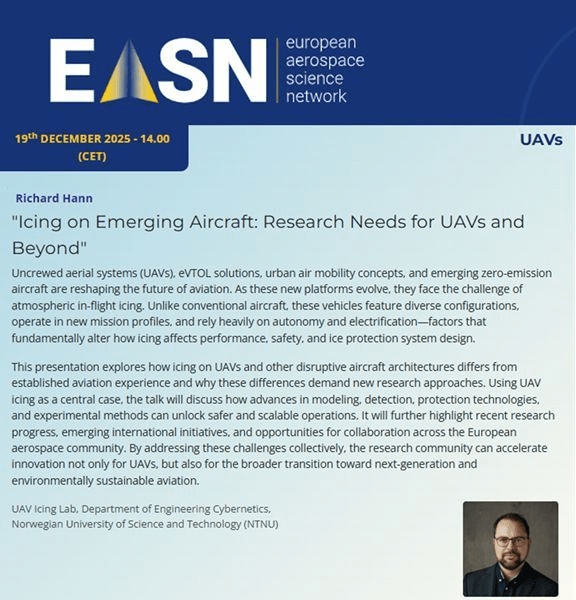
I’m very honoured to be invited to speak about this at the European Aerospace Science Network (EASN) research webinar on 19th December at 14:00 CET. In my talk titled “Icing on Emerging Aircraft: Research Needs for UAVs and Beyond”, I’ll introduce why icing remains such a pressing challenge for unmanned and disruptive aircraft—and why the solutions we need must be reframed entirely for these new classes of vehicles. Tune in for a free online webinar just before the holiday break! (Link: https://lnkd.in/eWb49vag)
Why this topic matters
Unlike large airliners, UAVs and many emerging aircraft have:
- Very tight power, weight, and size constraints, making traditional ice protection systems often unfeasible.
- High sensitivity to even small amounts of ice, since ice accretion alters aerodynamic performance dramatically—reducing lift, increasing drag, and degrading control effectiveness.
- A growing range of operational missions, from scientific data collection in Arctic regions to beyond-visual-line-of-sight commercial flights, where icing risk cannot simply be avoided.
Our recent work at the UAV Icing Lab has shown the deep influence of icing on UAV performance and the need for new modelling, detection, mitigation, and protection approaches tailored to these platforms. From optimized electro-thermal ice protection systems for propellers to assessments of aerodynamic penalties and the emerging integration of mission planning with icing risk indices, this field is rapidly evolving to support the next generation of operations.
Key themes in the talk
In the webinar I’ll discuss:
- Fundamental differences between icing effects on conventional aircraft and on UAVs or disruptive configurations.
- Why autonomy and electrification change the game for icing research, including how sensing, control, and power budgets interact with icing challenges.
- Advances in modelling and experimental methods that unlock safer and more scalable solutions.
- Recent research highlights and emerging collaboration opportunities across the European aerospace community to accelerate innovation—not only for UAVs but for the broader transition toward next-generation, environmentally sustainable aviation.
Looking forward
This talk is both a summary of where the field stands and a call to the aerospace research community: as we push aircraft into new domains of autonomy, sustainability, and performance, we must not overlook the atmospheric hazards that accompany these innovations. In-flight icing is one such hazard where tailored research and multidisciplinary solutions will be critical for the future of unmanned and disruptive aircraft alike.
 UAV Icing Lab